Roof Replacement in Wyoming, MI
Last updated: September 2026
Roof replacement in Wyoming, MI arrives earlier than it does in the metro’s newer suburbs, because Wyoming’s houses are older. Census estimates put the city’s median structure at 1969 and roughly 39 percent of its 30,800-odd housing units at pre-1960 — which means a large share of Wyoming roofs are on their second or third covering and are running out of legal room to add another. Grand Rapids Roofing Pros is an independent dispatch service that connects Wyoming homeowners with licensed local roofers who tear off, rebuild the eave detail to current Michigan code, and pull the permit through the city’s own Inspections Department. Call now to get matched.
Ready to talk to someone about your roof?
Call to reach the licensed local roofer you’re matched with in Grand Rapids & West Michigan.
Call (901) 704-8932When you call, stay on the line for a few seconds while we match you with the licensed local roofer for your area. Have your address and a quick description of the problem ready.
Call now for a licensed local roofer
Call now and we’ll connect you by phone with the licensed local roofer you’re matched with — no phone tag, no obligation.
📞 Call Now — (901) 704-8932We connect homeowners with independent licensed roofing professionals in the Grand Rapids area. We are not a licensed contractor and do not perform roofing work ourselves.
When does a Wyoming, MI roof need full replacement instead of repair?
The practical trigger in Wyoming is usually layers and deck condition rather than age alone. Michigan’s residential code bars installing a new covering over an existing roof where two or more applications are already in place, where the existing deck or covering is water-soaked or deteriorated past serving as a base, or where the existing covering is wood shake, slate, clay, cement or asbestos-cement tile. On a city where two in five homes predate 1960, hitting that second-layer ceiling is common. Add widespread granule loss, cupped or cracked shingle tabs, repeated ice-dam leaks at the same eave, or soft spots underfoot on the deck, and replacement stops being the expensive option and becomes the only compliant one.
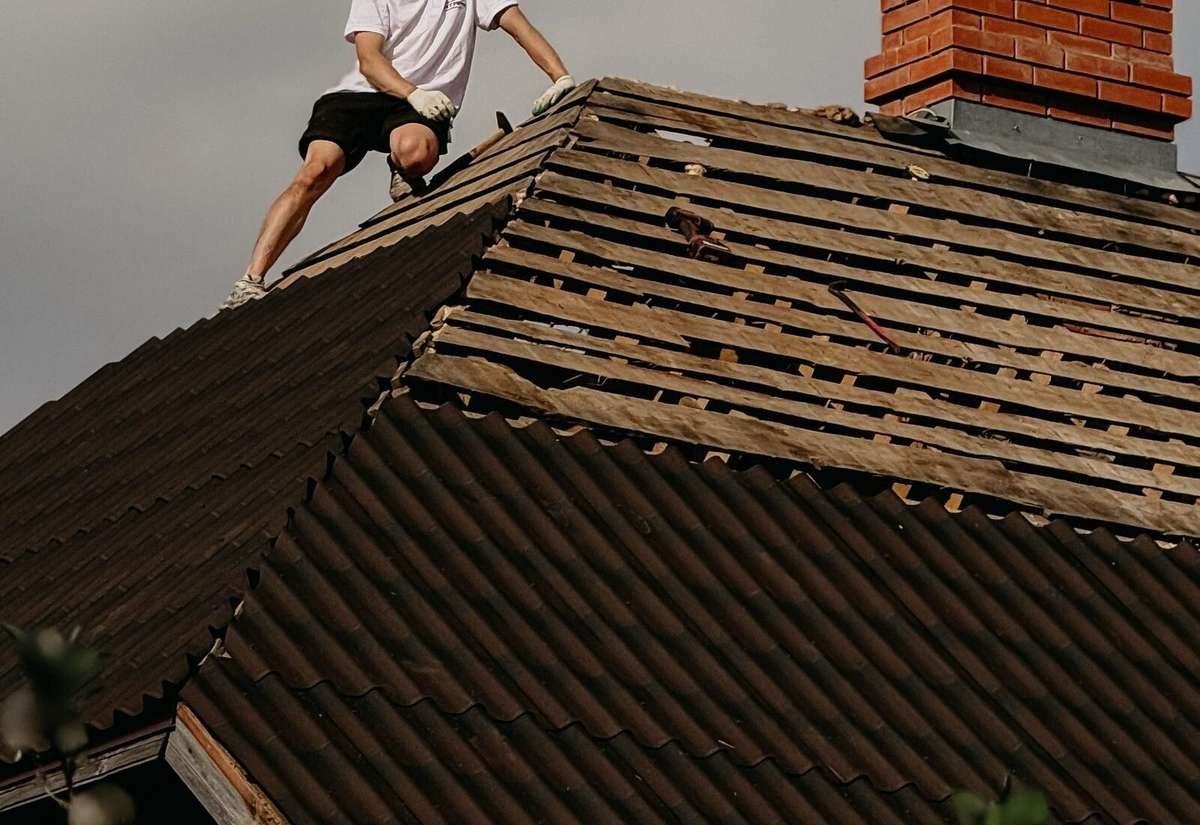
Wyoming’s age profile is what pushes most jobs to a tear-off
A recover, or roof-over, lays new shingles on top of the old covering. It is legal in Michigan in narrow circumstances and it is genuinely cheaper on the day. But the code closes that door under specific conditions, and the most common one in older housing is simply that the roof already carries two applications. It also closes when the deck below is water-soaked or has deteriorated past serving as an adequate base — and repeated ice-dam intrusion at an eave is one of the ways decking quietly gets there.
A tear-off is also the only version of the job where the assembly underneath is visible. Sheathing gets inspected and replaced where it is soft, the eave ice barrier gets installed to the current requirement, flashing at chimneys and sidewalls gets renewed rather than reused, and ventilation gets corrected while the roof is open. On a Wyoming house from the 1950s, that hidden work is usually the part that determines whether the next twenty winters are quiet.
What sends a Wyoming roof from repair to replacement
- Two or more existing layers already on the roof.
- Deck that feels soft or spongy underfoot, or daylight visible at the eave from the attic.
- Granule loss heavy enough that gutters fill with grit every spring.
- The same eave leaking every thaw despite past patch repairs.
Why replacement in Wyoming is a different conversation
Three things a roofer should know about Wyoming before scoping a replacement.
An older median than any of its neighbors
Wyoming’s median structure year of 1969 sits ahead of Grandville at 1978, Kentwood at 1983 and Walker at 1984. Older stock means more roofs already carrying a second layer, and more decks that have seen a full service life of West Michigan winters.
Three build eras across one city
The city’s master plan describes prewar and postwar neighborhoods in the north, mid-century suburban development through the center, and newer building in the south, including the area the plan calls the Panhandle. A scope written for one of those eras does not transfer to another.
Permits are handled in person, in Wyoming
The City of Wyoming runs its own Inspections Department at 1155 28th Street SW. Electrical, mechanical and plumbing permits moved online, but the city’s published guidance keeps building permits — the ones needing plans and fuller staff review — as in-person applications.
What a code-current replacement puts back on a Wyoming roof
The parts of a re-roof that are invisible from the street and decide how it performs.
The eave ice barrier, measured correctly
Michigan’s residential code requires an ice barrier in areas with a history of eave ice: either two layers of underlayment cemented together or a self-adhering polymer modified bitumen sheet, running from the lowest edge of every roof surface to a point at least 24 inches inside the exterior wall line. On roofs of 8:12 or steeper it must also run at least 36 inches measured along the slope from the eave edge.
The measurement point matters and is frequently described wrong. It is 24 inches inside the wall line, not 24 inches up from the drip edge, so on a Wyoming ranch with a typical overhang the membrane covers the entire overhang plus two feet of heated-wall roof. Given that Grand Rapids averages 77.6 inches of snow a year and roughly 83 days that cross freezing in both directions, that band is doing real work.
Decking, fasteners and the details that get skipped
With the old covering off, the sheathing is finally visible. Michigan code requires asphalt shingles to be fastened to solidly sheathed decks, with fasteners penetrating through the roofing material and at least three quarters of an inch into the sheathing, or fully through it where the sheathing is thinner. It also sets a minimum of four fasteners per strip shingle. Those are small numbers that decide wind performance.
The code is equally specific about what may not be reused: existing vent flashing, metal edging, drain outlets, collars and metal counterflashing are not to be reinstalled where they are rusted, damaged or deteriorated. And a cricket or saddle is required on the upslope side of any chimney or penetration wider than 30 inches measured across the slope — a detail worth checking on older Wyoming chimneys.
Underlayment and slope on ranch-era rooflines
Slope changes the assembly. Michigan code allows asphalt shingles only on roofs of 2:12 or greater, and between 2:12 and 4:12 it requires two layers of underlayment — a 19-inch starter strip at the eave and then 36-inch sheets overlapping 19 inches — where 4:12 and steeper needs a single layer with two-inch laps and end laps offset six feet.
That distinction bites on lower-slope roof planes, which are common on mid-century additions, porch roofs and attached garages across Wyoming. Two adjacent planes on the same house can legitimately require different underlayment build-ups, and a scope that treats the whole roof as one number can miss it.
Permits and who is allowed to do the work
Wyoming issues its own permits rather than routing them to Kent County or a private inspection firm. The Inspections Department sits at 1155 28th Street SW and can be reached at 616-530-7285; the city’s online permit brochure states that building permits requiring detailed plans and more thorough staff review must still be applied for in person. Whether a specific reroof requires a permit is a determination for the building official, not something a website should promise either way.
On licensing, Michigan names roofing directly among the crafts covered by a residential builder or maintenance and alteration contractor license through LARA, and the exemption applies only to work under an aggregate contract price of 600 dollars, with a clause preventing a larger job from being split into smaller contracts to evade it. Michigan also holds no license reciprocity with other states. Every roofer in our network is licensed and independent of us.
Other roofing help for Wyoming homeowners
Replacement decisions usually start with one of these.
Ice Dam Removal in Wyoming
The winter problem that most often exposes a failing eave and starts a replacement conversation.
See ice dam removalStorm Damage in Wyoming
Wind and hail documentation before an insurance claim, on the same older Wyoming housing stock.
Explore storm damageAll Roofing in Wyoming, MI
The city-wide overview: corridors, neighborhoods and every roofing service we match in Wyoming.
See the city guideRoof Replacement — Metro Guide
Our full West Michigan replacement guide: materials, sequence and what a code-current re-roof includes.
Read the metro guideMichigan’s Eave Ice-Barrier Rule
A closer look at R905.1.2, what the 24-inch measurement really covers, and why older roofs often lack it.
Read the code guideNot sure if it is time?
Describe what you are seeing and call now. We route you to a licensed roofer who works Wyoming roofs.
Get matched nowThe numbers behind a Wyoming replacement decision
U.S. Census ACS estimate for the City of Wyoming — older than Grandville, Kentwood or Walker.
Michigan Residential Code R908.3 bars a new covering where two or more applications already exist.
R905.1.2 minimum run inside the exterior wall line — plus 36″ along slope on roofs 8:12 and steeper.
NOAA/NCEI 1991–2020 normal at Gerald R. Ford International Airport, the load every Wyoming roof carries.
Sources: NOAA/NCEI 1991–2020 Climate Normals (Gerald R. Ford International Airport); U.S. Census Bureau, American Community Survey 5-year estimates (median year structure built, City of Wyoming); Wyoming [re]Imagined Master Plan (adopted 2021); Michigan Residential Code R905.1.2 and R908.3; City of Wyoming Inspections Department.
Wyoming corridors and neighborhoods we cover
From the prewar and postwar streets in the north, through the mid-century belt around 28th and 36th, out to the newer Panhandle subdivisions in the south.
Roof replacement in nearby cities
Questions Wyoming homeowners ask about replacement
Can I just add a second layer of shingles instead of tearing off?+
Sometimes, but Michigan’s code closes that option in several situations: where two or more applications are already on the roof, where the existing roof or covering is water-soaked or deteriorated past serving as an adequate base, where the existing covering is wood shake, slate, clay, cement or asbestos-cement tile, and for asphalt shingles in areas subject to moderate or severe hail exposure. On Wyoming’s older stock the two-layer ceiling is the one homeowners hit most often.
Does a replacement in Wyoming need a city permit?+
Wyoming issues its own permits through its Inspections Department at 1155 28th Street SW rather than through Kent County or a private firm, and the city states that permits requiring detailed plans and more thorough staff review, such as building permits, must be applied for in person. Whether your particular job needs one is a determination for the city’s building official; a roofer who pulls Wyoming permits regularly will know the current practice.
What does the eave ice barrier actually have to cover?+
Michigan Residential Code R905.1.2 requires it to run from the lowest edge of all roof surfaces to at least 24 inches inside the exterior wall line, using either two cemented layers of underlayment or a self-adhering polymer modified bitumen sheet. On roofs 8:12 and steeper it must also extend at least 36 inches measured along the roof slope from the eave edge. Because the measurement is taken inside the wall line, the protected band on a home with an overhang is wider than two feet of roof.
Does my roofer have to be licensed in Michigan?+
Michigan names roofing explicitly among the crafts covered by a residential builder or maintenance and alteration contractor license administered by LARA, and the statutory exemption applies only where the aggregate contract price is under 600 dollars, with language preventing a larger job from being split into smaller contracts. Michigan also has no license reciprocity with other states. We only match homeowners with licensed, independent roofers.
Do you replace roofs yourselves?+
No. Grand Rapids Roofing Pros is an independent dispatch and matching service. We connect Wyoming homeowners with licensed, independent local roofing professionals; we do not perform roofing work, and we do not guarantee any specific contractor, price, timeline or insurance outcome.
About this guide: Researched from NOAA/NCEI climate normals for Gerald R. Ford International Airport, NWS Grand Rapids storm summaries, the Michigan Residential Code, Michigan LARA licensing rules, and the City of Wyoming’s adopted master plan and Inspections Department guidance by the Grand Rapids Roofing Pros research team. We are a homeowner-to-roofer matching service; we do not perform roofing work ourselves. Learn more About Us or see How We Vet Roofing Partners.
Get matched with a licensed local roofer
Call now and we will connect you with a licensed West Michigan roofer who scopes the tear-off, the deck and the eave detail before quoting anything. No phone tag, no obligation.
Call now for a roofer
Independent dispatch service connecting homeowners with licensed local roofing professionals. We are not a roofing contractor.