What Actually Causes Roof Leaks in Grand Rapids
Most Grand Rapids roof leaks trace back to one of three causes, and which one you’re dealing with usually depends on the calendar. Grand Rapids Roofing Pros is an independent dispatch service that connects West Michigan homeowners with licensed local roofers, but knowing which of these three you’re facing is the first step toward the right repair.
Source: GAF Roofing Basics on common failure points and flashing/underlayment mechanics.
Ready to talk to someone about your roof?
Call to reach the licensed local roofer you’re matched with in Grand Rapids & West Michigan.
Call (901) 704-8932When you call, stay on the line for a few seconds while we match you with the licensed local roofer for your area. Have your address and a quick description of the problem ready.
Call now for a licensed local roofer
Call now and we’ll connect you by phone with the licensed local roofer you’re matched with — no phone tag, no obligation.
📞 Call Now — (901) 704-8932We connect homeowners with independent licensed roofing professionals in the Grand Rapids area. We are not a licensed contractor and do not perform roofing work ourselves.
Quick answer: what causes most roof leaks in Grand Rapids?
Grand Rapids roof leaks fall into three seasonal causes. Ice dam backup, running December through March, forces meltwater up under sound shingles when a standing snowpack refreezes at the eaves. Freeze-thaw cycling follows in March and April, working loose flashing, nail pops, and worn valleys as the region swings across freezing. Summer convective storms bring the third cause, wind and hail damage. A licensed local roofer, matched through this site, can diagnose which pattern applies from when and where the leak appeared.
The three causes, in the order you’ll run into them
This isn’t a guess — it follows directly from how long each damage window stays open on a Grand Rapids roof each year. See our full roof repair overview for how a licensed local roofer approaches diagnosis on each one.
1. Ice dam backup (Dec–Mar)
Grand Rapids holds a standing snowpack for weeks at a stretch — on average 28.7 days a year with 5″+ of snow depth on the ground, concentrated in January and February. That long window is what makes ice dam backup the most persistent cause: attic heat melts the pack from below night after night, not just during one storm.
2. Freeze-thaw flashing & valley wear (Mar–Apr)
As the season turns, Grand Rapids swings repeatedly above and below freezing rather than warming in a straight line. That whipsaw works into small gaps at flashing, nail heads, and valleys until they start leaking. Full breakdown in our spring freeze-thaw damage guide.
3. Wind & hail damage (summer storms)
Warm-season convective storms are a separate, event-driven cause unrelated to snow or freeze-thaw. They’re less frequent than the two cold-season patterns above but can cause sudden, obvious damage. See storm & hail damage roof repair for what to document.
Why ice dam backup tops the list
An ice dam leak doesn’t mean your shingles failed. Heat leaking into an under-insulated attic melts the underside of the snowpack sitting on the roof; that meltwater runs down to the cold eave overhang and refreezes into a ridge of ice. Each new melt cycle adds water behind that ridge until it’s forced uphill, under otherwise sound shingles, and into the ceiling below. Because Grand Rapids typically holds a multi-week snowpack through December, January, and February, this cycle can repeat for the better part of three months on an under-ventilated roof.
That’s why a winter ceiling stain in Grand Rapids should be checked at the eaves, valleys, and attic first, rather than assumed to be a shingle problem — see our full walkthrough on how ice dams form on West Michigan roofs and how to tell an ice-dam leak from a shingle failure.
Quick self-check: is it ice dam backup?
- Stain appeared December–March, especially during or right after a thaw
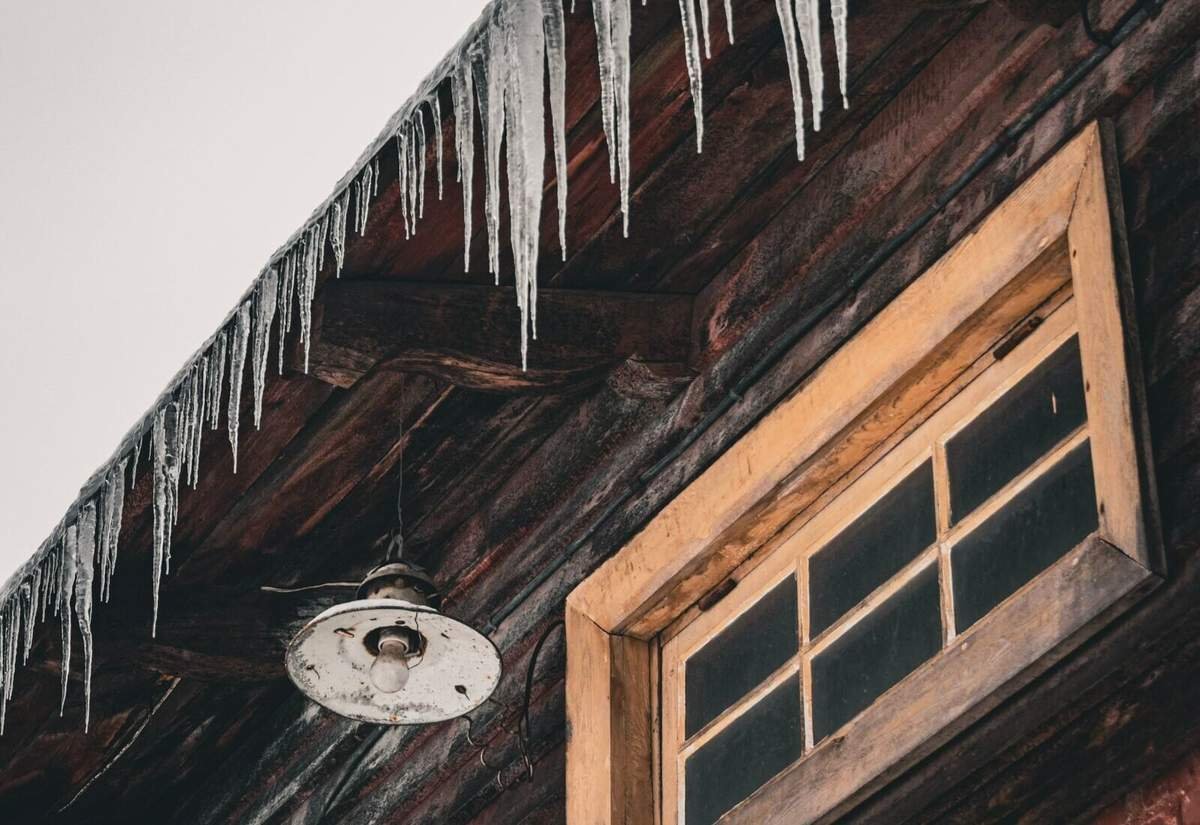
- Visible ice ridge or heavy icicles along the eaves
- Shingles look undamaged from the ground
- Staining is near an upper-floor exterior wall, not a random interior spot
Quick self-check: is it freeze-thaw wear?
- Leak showed up March or April, after the deep-winter snowpack was gone
- Location tracks a valley, chimney, or vent flashing rather than a flat field of shingles
- You can see curled, lifted, or cracked flashing or shingle edges nearby
- The leak comes and goes with daytime melt, overnight refreeze cycles
Why late winter brings a second wave of leaks
Grand Rapids’ snow tapers fast — from roughly 7.6″ in March down to about 2.0″ in April — but the temperature doesn’t settle above freezing in a straight line. It swings back and forth, melting by day and refreezing overnight, repeatedly. That freeze-thaw cycling is what finishes off flashing, nail pops, and worn valleys that survived the deep-winter snow load: small gaps expand and contract until water starts working its way through, most often at a roof valley or a flashing seam rather than across an open shingle field.
This is a different repair conversation than ice dam backup — it’s usually a targeted flashing or valley fix rather than an attic-side diagnosis. Full explainer: spring freeze-thaw roof damage in Grand Rapids, and if the leak is tracking a valley specifically, see valley & flashing leak repair.
Why the cause matters more than the symptom
A ceiling stain looks the same on the surface no matter which of the three causes made it — but the fix is different for each one, and a cosmetic patch that ignores the actual cause tends to come back.
Note the timing
Dec–Mar points toward ice dam backup; Mar–Apr points toward freeze-thaw wear; a leak right after a storm points toward wind or hail.
Note the location
Near an eave or upper exterior wall suggests ice dam; a valley or flashing seam suggests freeze-thaw; a random field spot suggests impact damage.
Check from the outside
An ice ridge, curled flashing, or visibly missing/cracked shingles each point toward a different one of the three causes.
Get matched, not guessed
A licensed local roofer can confirm the cause on-site and repair the actual source, not just the ceiling stain.
Questions Grand Rapids homeowners ask
Is every winter roof leak in Grand Rapids an ice dam?+
Not every one, but it’s the leading cause in the December–March window, because Grand Rapids typically holds a standing snowpack for weeks at a time. A leak appearing during that window, especially near an eave or upper exterior wall, should be checked for ice-dam backup before anything else.
Why do roof leaks in Grand Rapids spike again in March and April?+
That’s Grand Rapids’ freeze-thaw whipsaw window — repeated melt-by-day, refreeze-by-night cycles that finish off marginal flashing, nail pops, and worn valleys that survived the deep-winter snow load. It’s a different cause and a different repair than an ice dam leak.
Can wind or hail cause a leak without any missing shingles?+
Yes. Wind and hail can bruise or lift a shingle edge, or work water under flashing, without stripping shingles outright. If a leak starts right after a summer storm, it’s worth a look even if the roof looks intact from the ground — see our storm damage documentation guidance.
How do I know which of the three causes my leak is?+
Start with when it appeared and where it’s located. December–March near an eave points to ice dam backup; March–April near a valley or flashing seam points to freeze-thaw wear; a sudden leak right after a storm points to wind or hail. A licensed local roofer can confirm it on-site.
Does a repaired ceiling stain mean the leak is fixed?+
Not necessarily. Patching drywall addresses the symptom, not the cause. If the underlying issue — an eave ice ridge, a worn valley, or storm-damaged flashing — isn’t repaired, the same stain typically returns the next time that season’s conditions repeat.
Roof leak diagnosis & repair across Grand Rapids & Kent County
We connect homeowners with licensed roofers throughout the Grand Rapids metro and surrounding West Michigan communities, whatever the cause of the leak.
Older ranch and split-level roofs common in Wyoming and Kentwood tend to see more ice dam backup along their long, low eaves, while the complex, multi-valley rooflines common in Ada, Cascade, and Forest Hills see more valley and flashing leaks. See our full roof repair service overview or explore the roof inspection, roof replacement, and ice dam removal pages for related services, or start from our Grand Rapids Roofing Pros homepage.
Continue the roof-repair series
Get matched with a licensed Grand Rapids roofer
Call now and we’ll connect you with a licensed West Michigan roofer to diagnose the cause and repair it. No phone tag, no obligation.
Call now for a roofer
Independent dispatch service connecting homeowners with licensed local roofing professionals. We are not a roofing contractor.