Why Does My Ceiling Stain After It Snows?
If a Grand Rapids or West Michigan ceiling stain shows up during or right after a snowmelt — not during a rainstorm — the most common cause is an ice dam backing meltwater up under the shingles, not a failed roof. Grand Rapids Roofing Pros is an independent dispatch service that connects homeowners with licensed local roofers for diagnosis; here is why the timing points to an ice dam and what to check first.
Call now for a licensed local roofer
Call now and we’ll connect you by phone with the licensed local roofer you’re matched with — no phone tag, no obligation.
Ready to talk to someone about your roof?
Call to reach the licensed local roofer you’re matched with in Grand Rapids & West Michigan.
Call (901) 704-8932When you call, stay on the line for a few seconds while we match you with the licensed local roofer for your area. Have your address and a quick description of the problem ready.
We connect homeowners with independent licensed roofing professionals in the Grand Rapids area. We are not a licensed contractor and do not perform roofing work ourselves.
Quick answer: it’s usually an ice dam backing water up under the shingles
A Grand Rapids ceiling stain that shows up during or right after a snowmelt, especially between January and March, is more often an ice-dam backup than a shingle failure. Warm attic air melts the underside of the snowpack, the meltwater refreezes into a ridge at the cold eave, and later meltwater is forced up under otherwise-sound shingles because it can’t drain past the ice. If that timing matches what you are seeing, we can match you with a licensed local roofer to inspect the eave and attic.
Does the stain track with a thaw, or with a rainstorm?
Timing is the single best diagnostic clue available without going into the attic. A stain that appears during a rainstorm, in any season, points toward a shingle, flashing, or valley problem somewhere in the roof field. A stain that appears during or immediately after a stretch of snowmelt — particularly in January, February, or March — and then seems to pause once temperatures drop back below freezing, points toward an ice dam: the water supply is meltwater being forced upward, and it slows or stops when the refreeze cycle locks it back in place.
Location matters too. Ice-dam staining typically shows up near an exterior wall on an upper floor, close to where the eave sits below, rather than in the middle of a room.
An intact-looking roof doesn’t rule out an ice dam
This is the part that confuses a lot of homeowners: an ice dam forces water up and under the shingle laps from below, rather than punching through them from above. That means a roof can look completely undamaged from the ground — no missing shingles, no obvious hole — and still be actively leaking at the eave. A cosmetic ceiling repair without addressing the eave and the attic-side cause almost always recurs at the next thaw, because the underlying mechanism was never interrupted.
Ice-dam backup vs. an actual shingle or flashing failure
The fix is different depending on which one you’re dealing with — this is the fastest way to tell them apart before a roofer arrives.
Points to an ice dam
- Stain appears during or right after a snowmelt, Jan–Mar
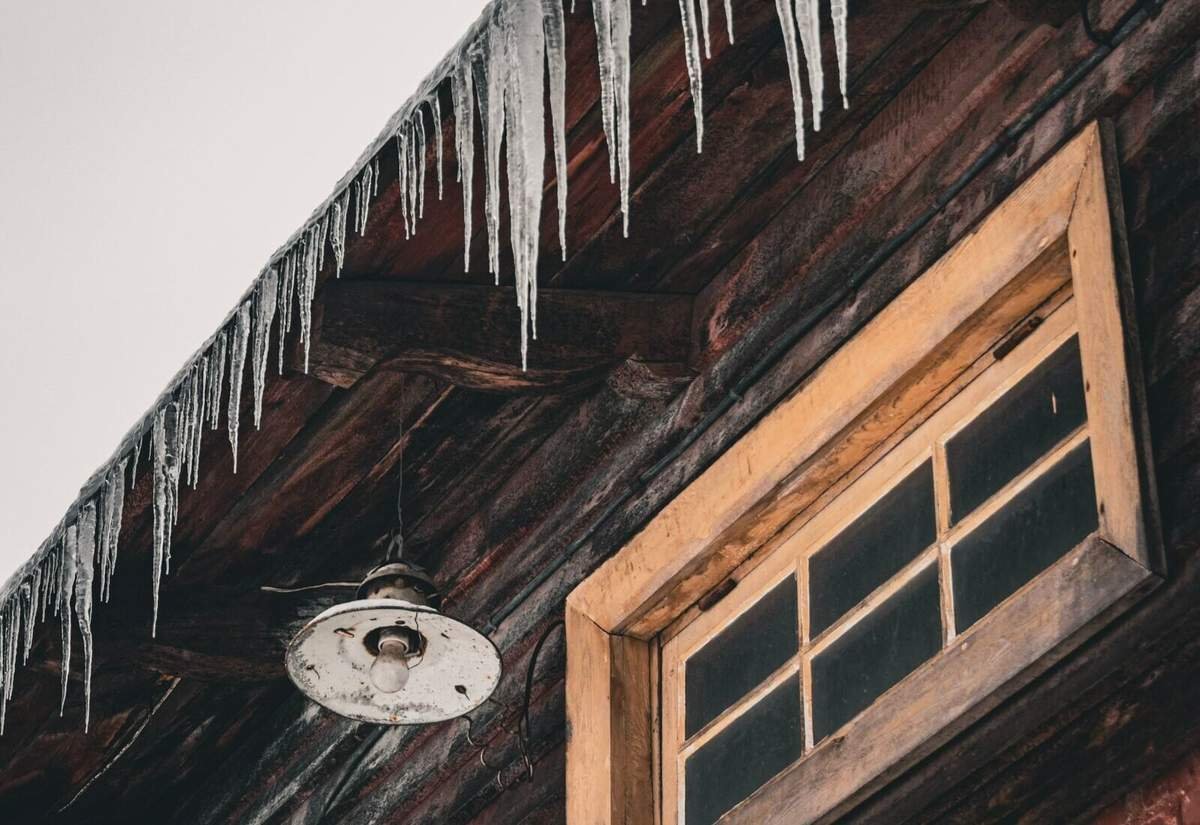
- Visible ice ridge or icicles at the eaves nearby
- Stain is near an upper-floor exterior wall
- Staining pauses once it refreezes, resumes at next thaw
- Shingles look undamaged from the ground
Points to a shingle/flashing issue
- Stain appears during an active rainstorm, any season
- Visible missing or lifted shingles, or damaged flashing
- Stain location tracks to a valley or chimney/vent penetration
- Leak is consistent regardless of temperature or snowmelt
- No unusual ice buildup at the eaves
For the full side-by-side walkthrough, see our ice dam vs. shingle failure diagnosis guide, or the shorter self-check in how to tell if your roof leak is an ice dam.
Why Grand Rapids sees this pattern more than most markets
The mechanism behind ice-dam-driven ceiling stains depends on two things Grand Rapids has in abundance every winter: a standing snowpack that sticks around, and attics that leak heat into it. Grand Rapids averages 77.6 inches of snow a year, with roughly 60 inches of that falling in December, January, and February, the exact ice-dam window, per National Weather Service climate data for the Grand Rapids forecast area, and the region holds 5 or more inches of snow on the ground for an average of 28.7 days a year. That is weeks of standing snowpack for attic heat to work against, not a single storm’s worth.
If a licensed roofer confirms an ice dam is the cause, the correct fix pairs professional removal with an attic-side diagnosis — insulation, air-sealing, and ventilation — rather than a repeated ceiling patch. See our ice dam removal overview for what that process looks like, or roof repair if the source turns out to be a shingle or flashing issue instead.
What to check right now
- Look at the eaves from the ground for a thickening ice ridge
- Note whether the stain grew during a thaw or a rainstorm
- Check the attic, if safe, for frost or warm spots on the roof deck
- Photograph and date the stain for any future insurance documentation
Questions West Michigan homeowners ask
Why does my ceiling only stain in the winter?+
Because the cause is tied to the ice-dam mechanism, which only occurs when there’s a standing snowpack for attic heat to melt from below. A roof that’s fine in summer rain but stains in a winter thaw is a strong signal the source is an ice dam at the eave, not a general roof leak.
Can an ice dam cause a stain even if I don’t see icicles?+
Yes. Icicles are a common visible sign, but the ice ridge that actually traps water can be less obvious, especially on a roof with gutters or on the side that gets less afternoon sun. Interior staining timed to a thaw is still a meaningful clue even without visible icicles.
Will patching the ceiling stop the stain from coming back?+
Usually not on its own. A ceiling patch addresses the visible symptom, not the ice dam at the eave or the attic heat loss that caused it. Without an attic-side fix, the same stain typically reappears at the next significant thaw.
Does a ceiling stain always mean I need a full roof replacement?+
No. Many ice-dam-related stains are resolved with professional ice dam removal plus attic insulation, air-sealing, and ventilation work rather than a full reroof, especially if the shingle field itself is otherwise in good condition.
Is it worth documenting the stain even if I’m not filing an insurance claim yet?+
Yes. A dated photo of when the stain first appeared and how it progressed is useful either way, and Michigan sets specific statutory timelines for insurer response once a claim’s proof of loss is filed, so early documentation only helps if a claim does end up being filed.
Ceiling-stain diagnosis across Grand Rapids & Kent County
We connect homeowners with licensed roofers throughout the Grand Rapids metro and surrounding West Michigan communities.
Related homeowner guides
Get matched with a licensed Grand Rapids roofer
Call now and we’ll connect you with a licensed West Michigan roofer to diagnose the source and, if it’s an ice dam, address the attic-side cause. No phone tag, no obligation.
Call now for a roofer
Independent dispatch service connecting homeowners with licensed local roofing professionals. We are not a roofing contractor.