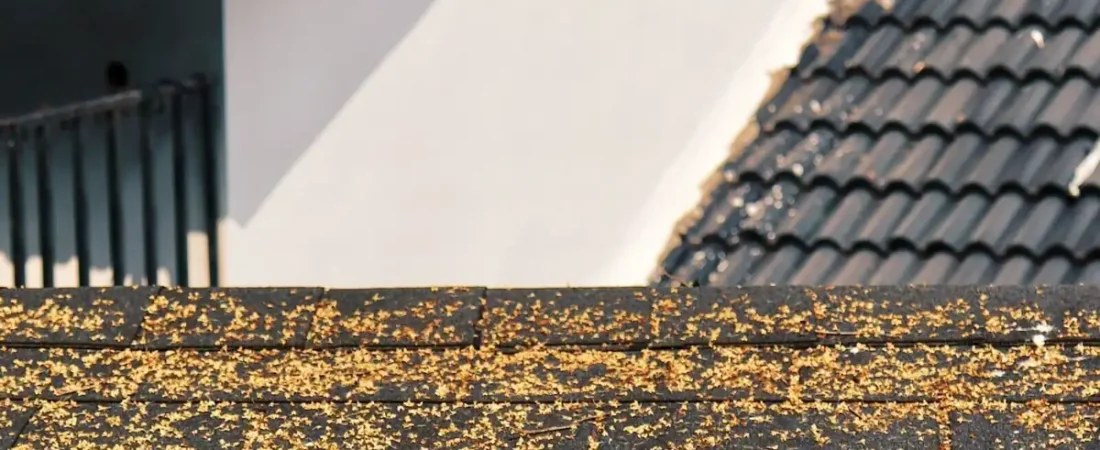
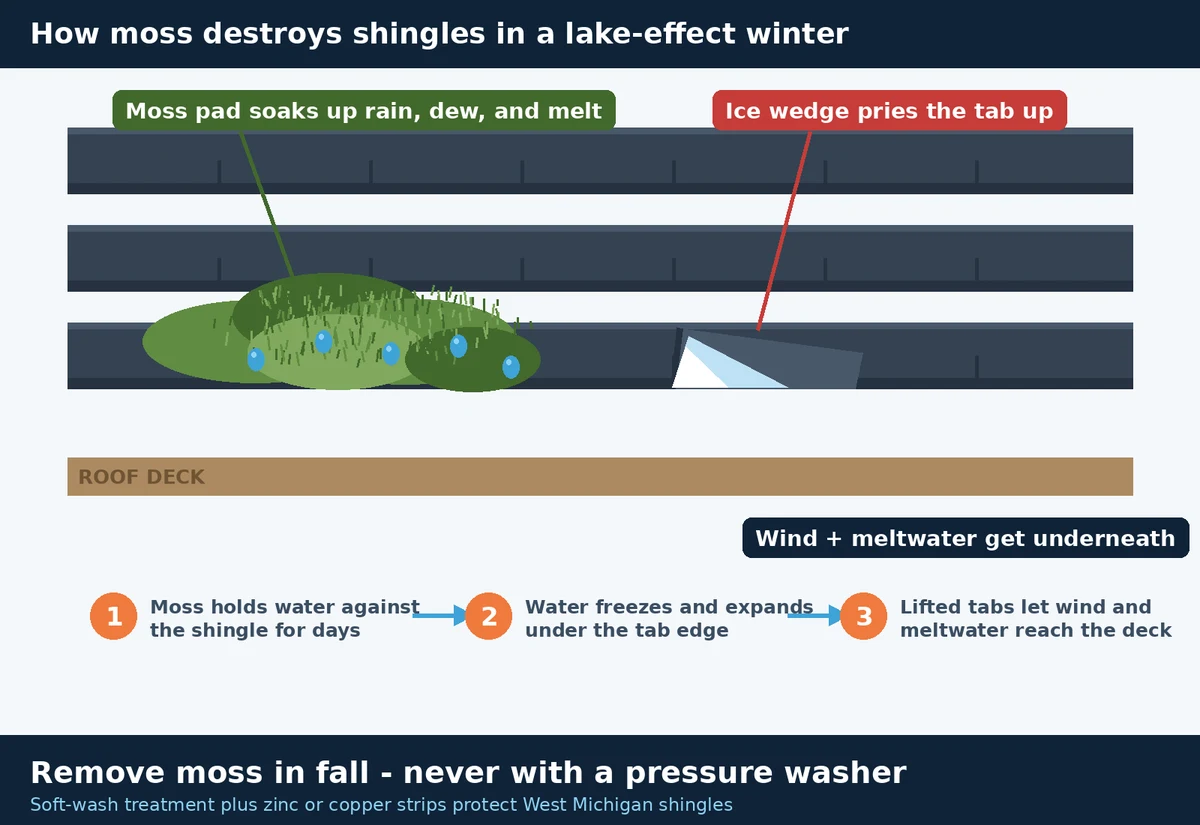
Moss on a Michigan roof is not just cosmetic — it works like a wet sponge stapled to your shingles. Through a West Michigan winter that sponge freezes and thaws over and over, prying shingle tabs upward and holding meltwater against the roof. Fall is the window to deal with it: treat the moss with a gentle soft-wash solution, never a pressure washer, and add zinc or copper strips to keep it from coming back. By the time snow flies, it is too late until spring.
Ready to talk to someone about your roof?
Call to reach the licensed local roofer you’re matched with in Grand Rapids & West Michigan.
Call (901) 704-8932When you call, stay on the line for a few seconds while we match you with the licensed local roofer for your area. Have your address and a quick description of the problem ready.
Drive any tree-lined street in Eastown, Alger Heights, or Forest Hills in October and you will spot them: green velvet patches creeping up the north slope of otherwise healthy roofs. Grand Rapids is a city that prizes its tree canopy — the city’s own urban forestry goal is 40% coverage — and the same shade that cools those streets in July keeps their rooftops damp long into the afternoon. Damp, shaded, and humid off the big lake: that is moss habitat, and West Michigan supplies it street after street.
Is Moss Actually Bad for an Asphalt Roof?
Yes — and in this climate, specifically because of winter. Moss anchors into the shingle surface and holds moisture against it around the clock. In a Georgia summer that means algae stains; in a Grand Rapids winter it means a saturated pad that freezes solid, expands, and physically lifts the shingle tab it sits under. Every thaw refills the sponge, every refreeze pries a little further. Lifted tabs then lose their wind resistance and give meltwater a path under the course — the same entry mechanism we cover in common roof leak causes.
Moss also shortens shingle life directly: it holds granules it has dislodged, keeps the mat wet, and accelerates the freeze-thaw wear that already costs lake-effect roofs years of lifespan compared to milder climates.
Why Is Fall the Right Time to Remove Moss in Michigan?
Three reasons, all seasonal:
- Treatment needs above-freezing weather. Moss-killing solutions need time on a dry-ish, thawed roof to work. October in Grand Rapids still offers those windows; December does not.
- Dead moss must come off before snow. A treated-but-still-attached moss pad under the winter snowpack behaves exactly like a live one — a frozen sponge under the tabs. Treat, wait, then remove.
- It pairs with the fall roof routine. Moss removal slots naturally into the fall roof inspection checklist and lake-effect winter prep — the same visit that clears gutters can treat the north slope.
What Is Safe to Use on Asphalt Shingles — and What Never Is?
The asphalt roofing industry’s own guidance is blunt: ARMA recommends a gentle solution — roughly a 50:50 mix of household bleach and water, applied with a sprayer, rinsed with low pressure — and warns against pressure washing in any form. A pressure washer strips the granules that are the shingle’s entire weather armor; it removes moss and years of roof life in the same pass.
The safe sequence looks like this:
- Apply the diluted solution on a cool, overcast fall day, protecting plantings below the eaves.
- Let it dwell per the label — the moss browns and releases its grip over days to weeks.
- Remove the dead material with a soft brush working down-slope, never up under the tabs.
- Install zinc or copper strips at the ridge; rain washes trace metal ions down the slope and suppresses regrowth for years.
- Where shade is the root cause, prune the offending limbs — otherwise the moss returns on the same schedule as the shade.
When Is Moss a Sign of a Bigger Roof Problem?
Moss is sometimes the messenger. Heavy growth concentrated along one course can mean that area stays wet for a structural reason — a low spot, a failing valley or flashing detail, or gutters overflowing onto the slope, the same moisture chain covered in our gutter and ice dam prevention guide. And on a roof already at the end of its lifespan, moss that has been prying tabs for years may have done damage that treatment cannot undo: curled, cracked, or bald shingles under the pads. That is the point where a professional look — before winter, not after — tells you whether you need targeted roof repair or are starting the repair-vs-replace conversation.
Moss patches on the shady side of your roof? Get matched with a licensed, insured local roofer for a pre-winter roof inspection — free matching, no obligation.
FAQ
Does moss removal damage shingles?
Done correctly — soft-wash solution, dwell time, gentle down-slope brushing — removal is safe for shingles with life left in them. Done with a pressure washer or stiff scraping, it strips granules and shortens the roof’s life. Brittle end-of-life shingles can be damaged by any handling, which is why bad moss on an old roof warrants an inspection first.
Do zinc and copper strips really prevent moss?
They meaningfully suppress it on the slope below the strip. Rainwater picks up trace metal ions and inhibits new growth. They will not kill an established moss pad, so they belong at the end of the sequence — after treatment and removal — not as a substitute for it.
Can I just leave the moss until spring?
You can, but you are choosing a winter of freeze-thaw prying under your shingle tabs, and spring treatment windows in Grand Rapids are wetter and shorter than fall ones. If moss is established now, a fall treatment is the cheaper path.
Why is moss worse on the north side of my roof?
Sun exposure. The north slope gets the least direct sun, dries slowest after rain and dew, and in tree-heavy Grand Rapids neighborhoods often sits in shade all day. Less drying time means more hours per week in the damp conditions moss needs.
Grand Rapids Roofing Pros is a free referral and matching service. We are not a licensed roofing contractor and do not perform roofing work ourselves. All work is performed by independent, licensed and insured local roofing contractors. This article is general educational information, not a product or code determination for any specific roof. Follow product labels and manufacturer guidance for any cleaning solution.